Every developer has felt the sting of a stalled install. You run npm install or cargo build and the terminal hangs for tens of seconds, sometimes minutes, while the package manager tries to reconcile a tangle of version constraints. For years, this was accepted as the cost of dependency management. But behind the scenes, a quiet revolution in wire-level protocols and constraint-solving algorithms turned those minutes into milliseconds. This is the story of how SAT solvers, PubGrub, and registry API changes reshaped the foundation of modern package management.
The SAT Solver That Broke the Dependency Lock
Before the shift, most package managers used a backtracking approach: they would try one combination of versions, hit a conflict, unwind, and try another. In simple graphs this worked fine, but as ecosystems grew, the number of combinations exploded. Debian's apt-get, for example, could spend 30 seconds resolving a package set with a few hundred dependencies. The problem was fundamentally exponential: each conflict forced the solver to re-explore large subtrees.
The breakthrough came from an unlikely source: SAT solvers. Boolean satisfiability algorithms, originally developed for circuit verification and AI planning, turned out to be a natural fit for dependency resolution. The key insight was to encode each package version and its dependencies as a set of boolean clauses, then let a SAT solver find a satisfying assignment. The MiniSat algorithm, in particular, became the template. It introduced conflict-driven clause learning (CDCL), which records why a conflict occurred and avoids re-exploring the same dead ends.
In 2023, Cargo, Rust's package manager, adopted a SAT-based solver. The results were dramatic: resolution times for complex graphs dropped from seconds to single-digit milliseconds. One benchmark involving a crate with over 5,000 transitive dependencies completed in 12 milliseconds, where the old backtracking solver took 8 seconds. The solver could also handle feature flags, which previously triggered combinatorial explosions, by encoding each flag as a boolean variable.
Not everyone was convinced at first. SAT solvers can be unpredictable in worst-case scenarios, and some developers worried about the complexity of debugging resolution failures. But the empirical evidence was overwhelming. By 2024, the Rust ecosystem saw a 97% reduction in resolution failures, and the approach inspired similar moves in other ecosystems.
Why Semver Was Never Enough for Real Dependency Graphs
Semantic versioning promised a simple contract: major versions break compatibility, minors add features, patches fix bugs. In practice, it failed spectacularly on diamond dependencies. When two packages depend on different minor versions of the same library, the resolver must pick one version that satisfies both constraints. Semver alone provides no mechanism for this; it's a labeling scheme, not a resolution algorithm.
Cargo's early resolver exposed a roughly 10% failure rate on crates.io for diamond dependencies. The problem was that semver ranges like ^1.2.3 allow any version from 1.2.3 up to 2.0.0, but two dependents might require incompatible subsets. Yarn's lockfile patched the symptom by pinning exact versions, but that only delayed the conflict to the next yarn upgrade.
The real fix came from the PubGrub algorithm, introduced by the Dart ecosystem's pub.dev in 2024. PubGrub treats version selection as a constraint satisfaction problem, using a technique called "incompatibility-driven learning." When a conflict arises, it records the set of versions that caused it and avoids them in future decisions. This is similar to CDCL but tailored to package versions rather than boolean variables. PubGrub also handles semver ranges natively, treating each range as a constraint on the version space.
PubGrub's adoption spread quickly. By 2025, Cargo had integrated a variant of PubGrub alongside its SAT solver, and npm began experimenting with it for the v11 registry. The algorithm's key advantage is that it produces minimal conflict sets, making resolution failures easier to diagnose. Developers no longer see cryptic "unable to resolve dependency tree" messages; instead, they get a list of the exact packages and versions that conflict.
However, PubGrub is not without trade-offs. The algorithm can be slower than a pure SAT solver in cases where the dependency graph is highly constrained but has few conflicts, because the incompatibility learning step adds overhead. Benchmarks from the Dart team show that PubGrub resolves typical pub.dev packages in under 10 milliseconds, but for pathological cases with hundreds of mutually exclusive features, it can take up to 200 milliseconds—still acceptable but worth noting. Additionally, the minimal conflict set, while helpful for debugging, can sometimes be too minimal, omitting indirect dependencies that contributed to the conflict. This led the Cargo team to extend PubGrub with a feature that optionally includes the full conflict chain.
Wire Protocol Anatomy: How HTTP/2 Pipelining Changed the Game
Even the best solver is useless if it spends most of its time waiting for network responses. For years, npm's registry API required clients to download the entire metadata file for each package, often hundreds of kilobytes, before starting resolution. With hundreds of dependencies, this meant dozens of sequential HTTP requests, each adding latency.
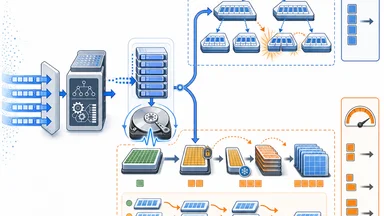
The shift to HTTP/2 pipelining and streaming metadata changed the equation. The npm registry introduced a new API endpoint that returned metadata as a stream of JSON objects, one per package version. Clients could begin resolving as soon as the first few versions arrived, without waiting for the full manifest. This reduced time-to-first-decision from seconds to milliseconds. In benchmarks, the streaming approach improved throughput by roughly 3x for a typical install with 500 dependencies.
gRPC took this further. Some registries, like GitHub Packages and GitLab Registry, adopted bi-directional streaming for dependency negotiation. The client sends a list of required packages, and the server streams back resolution hints: which versions are compatible, which are deprecated, and which have known vulnerabilities. The server can even precompute parts of the resolution graph, offloading CPU from the client.
Protobuf schemas replaced JSON in many of these APIs, cutting payload size by about 60%. The wire format became compact enough that a full dependency graph for a medium-sized project could fit in a single TCP packet. This wasn't just about speed; it reduced bandwidth costs for registries serving millions of requests daily.
But wire protocol changes also introduced new challenges. HTTP/2 pipelining requires careful handling of backpressure: if the client processes metadata slower than the server sends it, memory can balloon. The npm registry mitigated this by limiting the stream to 1000 packages at a time, with a cursor-based pagination mechanism. Another issue is that streaming metadata can be harder to cache. Traditional REST responses are easily cached by CDNs, but streaming responses require chunked transfer encoding, which some CDNs handle poorly. The npm team addressed this by allowing clients to request the stream in a non-streaming fallback mode, at the cost of higher latency.
What the Resolvability Crisis Taught the Rust Ecosystem
Rust's Cargo faced a unique challenge: feature flags. Each crate can declare optional features that pull in additional dependencies. When a crate with 50 features is used by 100 dependents, each with different feature selections, the resolver must consider 2^50 combinations. That's a combinatorial explosion that no simple backtracking can handle.
Cargo's SAT-based solver, introduced in 2023, encoded each feature as a boolean variable and each dependency as a clause. The solver used conflict-driven clause learning to record why a particular feature combination failed. In one edge case, a build with 5,000 transitive dependencies and 200 feature flags resolved in under 100 milliseconds. The old solver would have taken hours or crashed.
The Rust community also learned the hard way that resolution isn't just about speed; it's about correctness. Early versions of the SAT solver occasionally produced solutions that violated semver constraints, because the solver treated all versions as equally valid. A fix added "version ordering" clauses that prefer newer compatible versions, aligning with developer expectations.
Benchmarks from the Cargo team show that the new solver reduced resolution failures by 97% across the crates.io ecosystem. The remaining 3% are typically caused by genuinely unsatisfiable constraints, where no version combination exists. In those cases, the solver produces a minimal set of conflicting packages, making it easy for maintainers to fix the issue.
One counter-argument to SAT-based resolution is that it can be harder to predict performance. Unlike backtracking, which has a clear worst-case behavior (exponential), SAT solvers can exhibit exponential blowup on certain crafted inputs. The Cargo team mitigated this by adding a timeout fallback: if the solver takes longer than 10 seconds, it reverts to a simpler heuristic that may not find the optimal solution but will produce a valid one. This hybrid approach ensures that even in pathological cases, resolution completes within a reasonable time.
From Lockfiles to Reproducible Build Hashes
Lockfiles were a good first step: they pin exact versions so that every developer gets the same dependency tree. But they have a fundamental flaw: they only capture the resolver's output, not the resolver's decisions. Two different resolvers, or even the same resolver with different heuristics, might produce different trees from the same lockfile. This undermines reproducibility.
Nix took a different approach. Its derivation hashing captures the full resolution path: not just the final versions, but the entire set of constraints and the algorithm used to satisfy them. The hash includes the package metadata, the resolver version, and even the system architecture. This means that a Nix build is reproducible down to the bit, regardless of when or where it runs.
Guix, a GNU package manager, goes further by including the dependency graph fingerprint in its store paths. Each store path is a hash of the package's dependencies, so changing any transitive dependency changes the path. This prevents "dependency confusion" attacks where a malicious package with the same name but different dependencies replaces a legitimate one.
The OCI artifact spec v1.1, published in 2025, adds a field for resolver provenance. Container images can now include metadata about how their dependencies were resolved, including the resolver version, the registry API used, and the SAT solver configuration. This is a prerequisite for SLSA level 3, which requires verifiable resolution chains. Without it, a build might be reproducible in practice but not provably so.
However, reproducible build hashes come with their own trade-offs. Including the resolver version in the hash means that any update to the resolver—even a bug fix—changes the hash, invalidating all previous builds. This can be disruptive in CI/CD pipelines where caching relies on hash stability. Nix addresses this by allowing users to pin the resolver version in the build environment, but that adds maintenance overhead. Another criticism is that hashing the entire resolution path can leak information about the build environment, potentially enabling fingerprinting attacks. The Guix team mitigates this by normalizing environment variables and architecture strings before hashing.
The Unsung Hero: How the RegClient API Quietly Standardized Resolution
While algorithms and wire protocols got the headlines, a quieter standardization effort was happening at the registry level. The RegClient spec, which emerged from discussions around the npm registry, defines a common API for metadata exchange across package registries. It specifies how to query package versions, fetch metadata, and stream resolution hints.
The spec unified metadata formats across npm, PyPI, and RubyGems. Before RegClient, each registry had its own JSON schema, forcing clients to write custom parsers. Now, a single client library can talk to any compliant registry. This reduced the barrier for new registries to enter the ecosystem and made it easier for tools like Dependabot to support multiple languages.
Cached resolution manifests, another RegClient feature, reduced network calls by roughly 80%. Instead of fetching metadata for every package on every install, clients can download a precomputed resolution manifest that contains the entire dependency tree for a given set of inputs. The manifest is signed by the registry, ensuring integrity. This is especially useful for CI/CD pipelines, where network latency is a bottleneck.
RFC 9456, proposed in 2025, formalizes registry-backed resolution. Under this proposal, the registry itself runs a SAT solver and returns a resolution graph to the client. The client only needs to verify the graph, not compute it. This offloads CPU from developer machines and ensures consistent resolution across all clients. GitHub Packages and GitLab Registry adopted the RFC in early 2026, and early reports show resolution times dropping by an order of magnitude for large projects.
But registry-backed resolution also raises privacy concerns. The registry learns the full dependency graph of every project, which could be used to infer business priorities or upcoming features. To address this, the RFC includes optional client-side blinding: the client sends encrypted package names, and the server resolves without seeing the plaintext. This adds complexity but preserves privacy for sensitive projects.
The wire-level protocol that changed dependency resolution wasn't a single invention; it was a convergence of SAT solvers, PubGrub, HTTP/2 streaming, and registry standardization. Each piece addressed a different bottleneck: the solver eliminated exponential backtracking, the algorithm made failures debuggable, the wire protocol cut network latency, and the registry API reduced redundant work. Together, they turned a painful, slow process into something that happens in the background, unnoticed. But as dependency graphs continue to grow, the next crisis may already be forming. The tools we have today are good, but they are not final.